Showing posts with label marriage. Show all posts

Sunday, December 13, 2015

Cousin Love


I wrote a blog post some time back about the marriage record of two of my husband’s ancestors, John Garver and Mary Anne Overly.  One of the statements that had to sworn to in the State of Ohio in in 1848 was that the spouse was “not nearer of kin to me than first cousin.”

That led me wonder about the legality today of marrying one’s first cousin today…  And what I found out surprised me:  It’s still legal in many states!  I had no idea!

I started out by looking at the National Council of State Legislatures website.  There I learned that first cousin marriage is legal without restriction in today nineteen states and the District of Columbia—although North Carolina does stipulate that double-cousin marriage is prohibited.  (That would be two people who are cousins through both parental lines, therefore meaning that they share both sets of grandparents.)  In twenty five other states, first cousin marriage is prohibited. 

In the remaining six states, first cousin marriage is allowed under certain circumstances.  Five of those states (Arizona, Illinois, Indiana, Utah, and Wisconsin) require that the couple be either too old to have children (minimum age requirements of age 50, 55, or 65) or medically unable to reproduce.  The last (Maine) requires that the couple obtain a physician’s certificate of genetic counseling.

Second cousins may legally marry in all states.

So, those are the hard, cold facts…  But the larger question for me was, what kind of person does this?  How does it happen that two people come to the place in life where they fall in love with, and desire to marry, a first cousin?

For that viewpoint, I turned to a website called CousinCouples.com.  The website discusses the legalities, genetics, and history of first and second cousin marriage.  There are also discussion boards where cousins can share their stories, problems, and even wedding videos.  One thing resonates in their stories:  Their friends and families, almost without exception, disapproved.  Some of them say that their ministers had a problem with it, while others were married in their regular church.  Those who live in states where first cousin marriage is prohibited can still legally marry by having the marriage take place in another state where it is allowed.

On the website’s “Facts Page” they report that no European country, nor Mexico nor Canada, prohibit first cousin marriage, and that the frequency of cousin marriages in the United States is about 1 in 1,000.  They also state that “Children of non-related couples have a 2-3% risk of birth defects, as opposed to first cousins having a 4-6% risk.” 

Not much difference?  I found that hard to believe—but the  facts seem to back it up, based on a landmark study published in 2002 in the Journal of Genetic Counseling.  This study was referred to in almost every source I consulted, including a 20/20 television piece presented by John Stossel in August 2004 and a 2009 article in The New York Times.  More recent studies have come to the same conclusion.  The 20/20 article also said that every year in America, about 200,000 first cousins wed.

Statistics aside, bad things can happen, even if, statistically, they usually don’t...  One of my clients who knew I was writing a blog post on the topic of cousin marriage shared this personal story with me:  “My husband's aunt married her first cousin. They had three sons. The first one was born with severe arthritis and was crippled at a very young age, as well as being born almost legally blind. The second son was born mentally impaired and also almost legally blind, and he passed away quite young. The third son was born completely deaf.  The boys also had a very unusual appearance.”


Among notable figures in history who married a first cousin are Johann Sebastian Bach, Werner von Braun, Charles Darwin, Albert Einstein, Edgar Allen Poe, Queen Victoria, and H.G. Wells.  But—with no offense to my first cousins intended—for me it is still definitely too close for comfort!


Image:  bigstockphoto.com


Monday, June 15, 2015

Mystery Monday: Otis

I recently completed an ancestry binder for a co-worker—we’ll call her “Binny.”  She was my youngest client ever, and she wanted to know more about her paternal ancestry.  Binny knew only a few facts, and one of them was that her father’s father was a man named Otis Coleman.  Grandpa Otis soon became my favorite person on Binny’s tree.

Otis Coleman was born on February 9, 1918, according to various public records.  His obituary in the La Salle (Illinois) News Tribune (9-24-2001) corroborates this, saying, “He was born February 9, 1918, in Buchanan [Henry County], Tenn., to Richard and Ristie (Green) Coleman.”

So, I concluded that Otis’ parents—and therefore my client’s great-grandparents—were Richard and Ristie Coleman.  Or were they?

According to the Henry County, Tennessee marriage register that I found online, Richard Coleman and Miss Rista Green were married by a Justice of the Peace on January 3, 1920.  If Otis was really their child, it would have been more typical for them to marry before their child was born in 1918, not two years later—but it’s possible they weren’t.  


Moving ahead ten years, in the 1930 census for Henry County, Tennessee, Richard and Risty are listed with four children including Otis, and Otis is 12 years old.  His relationship to Richard is listed as “son.”  And they have been married for 16 years (since ages 21 and 19), which would be 1914—not correct...  They've extended their marriage back to encompass Otis' birth!


However—things got squidgy when I went back to the 1920 census.  Here are Richard, age 25, and Rista, age 16, married and living in Henry County, Tennessee, just where I expected them.  But—no child named Otis is listed!  No children at all…  So—where was Otis in 1920?


And wait a minute!…  If the 1920 census gives the correct age for Rista, then she was just 14 years old in 1918, the year that Otis was born.  Could Rista really have been his mother at such a young age?  I know it’s medically possible—but is it likely?

I took a closer look at Rista’s age.  According to the 1910 census record, listing her as age 6, she would have been born around 1904.  Her 1920 census with Richard, listing her as age 16, would also put her birth at around 1904.  Unfortunately, no ages are given on the 1920 marriage register. 

In 1930 she is listed as 35—very doubtful...  Findagrave.com wasn’t very helpful either, giving her birth as 1908—but no grave marker or other proof.  So the best evidence still points to Rista being born around 1904, and being no more than 14 when baby Otis was born in 1918.  

Binny and I want to know…  Who were Otis’ parents, really?  I did some digging online, and made a few phone calls, and although Henry County didn’t have birth certificates that old, I was glad to find out that the State of Tennessee began keeping them in 1916—just in time to have one for Otis’ birth in 1918—at least I hope so.  Compliance wasn’t 100% in those early days, as any genealogist knows.  Nevertheless, Binny and I ordered Otis’ birth certificate a couple of weeks ago—and now, all we can do is wait, and hope for some answers.


Sunday, January 4, 2015

Black Sheep Sunday: Philip Wyatt and His Three Elizabeths

My sister-in-law Susie has some interesting ancestors.  I’ve written about two of them before—sisters Anna Grimm Wyatt and Eva Grimm Wyatt.  Going back further in time, I discovered Philip Paul Wyatt—Susie’s great-great grandfather—who had three wives named Elizabeth, and seems to have been something of a wanderer.

Philip was born in Somerset, England, in 1821.  His father was a successful farmer who had eight children with his first wife, Susanna:  James (we’ll get back to him later), our boy Philip, Mary, Susanna, William, Joan, Rhoda (who kept a diary that survived), and Elizabeth. 

Philip was first married in England in 1844, to Elizabeth Quick.  The marriage record lists him as a “bachelor” and her as a “spinster”—in other words, first marriage for both.  Philip was a butcher by trade.  Soon they had a son named Mark John Quick Wyatt, born in 1845. 


Philip and his first Elizabeth were separated by 1848, and Philip was on his way to America.  What caused Philip to abandon his family—or did Elizabeth flee her husband?  Or perhaps she didn’t want to go to America?  In the 1851 English census, Elizabeth and her five-year-old son are living as lodgers in someone else’s home.  Her son Mark later emigrated to Australia, where his descendants can still be found.   (I’ve corresponded with one.)

Anyway, in July 1848 Philip’s name is found on a ship passenger list, arriving in New York City on the ship “Robert Peel.”  On the same ship, listed right after Philip, are George and Elizabeth Towils and their young son John—the same Elizabeth who would become Philip’s second wife. 


Philip and Elizabeth Rockett Towils were married two years later, in 1850.  (I wonder if Philip had a legal divorce from his first wife?)  They had four sons in the 1850s—Edward, Albert, Walter, and Adolphus—and also raised Betsy’s son John.   

The family didn’t stay in one place for long…  In the 1850 census their residence is Albion, New York, where Philip worked as a butcher.  By 1860 they lived in Terre Haute, Indiana with their sons—but seven-year-old Albert was born in Kentucky, so they most likely lived there after they left New York but before they came to Indiana, where their younger sons were born.

They didn’t tarry long in Indiana.  The 1866 Oshkosh City Directory lists Philip as a butcher on Ferry Street.  The 1868 Oshkosh directory lists him, surprisingly, as a “hop grower.”  What happened to the butcher shop?

In 1870 the family appears in the census records twice!  In January they were enumerated with all five sons in St. Joseph, Missouri—a popular layover point for those planning to head west in the spring.  Then in August they were enumerated in San Jose, California.  Philip is now a “brewer” and their oldest two boys are farm laborers.  (Stepson John had struck out on his own by then.)

But they must not have stayed long in California.  An 1875 newspaper ad which ran in the Terre Haute “Saturday Evening Mail” said this:  “For the finest roasts—the tenderest steaks—the juiciest chops—the nicest cutlets—the best breakfast bacon—the choicest meat of all kinds, go to Phil Wyatt, the well known English Butcher, who makes a specialty of this business.”


Philip’s second wife Elizabeth died in Indiana in 1877, of “chronic inflammation of the stomach,” according to her obituary, after being quite ill for three years.  Her obituary also contains this startling information:  “In accordance with the English custom Mrs. Wyatt requested that her body be kept for some time.  Her mother’s corpse was not interred until 16 days after death.”  The obit also says, “During all of her terrible sickness, Mrs. Wyatt displayed rare womanly fortitude.”  (Apparently fortitude was rare in women at that time.)


Philip soon moved on to Chicago.  In the 1880 census he is a widower aged sixty who lives with his son Albert and family (as do Philip’s other three sons).  Ten people in a Chicago apartment—it must have been tight quarters!  Philip is a butcher, and all four of his sons work in a butcher shop. 

Philip didn’t remain a widower for long.  His brother James, an attorney back in Somerset, England, had a fiancĂ© there—a wealthy spinster named Elizabeth Paull.  By 1881 Philip was living back in Somerset and he married his brother’s sweetheart there—making her Philip’s third Elizabeth.  On the marriage record, Philip states that he is a “cattle seller.”


Somehow, Philip ended up separated from this third Elizabeth, back in America, and living in Oshkosh, Wisconsin, perhaps to be closer to his sisters.  Philip died of “brain paralysis” in 1892 in Oshkosh.  His obituary in the Oshkosh “Daily Northwestern” says that he “ran a meat market on Main Street for some time but subsequently sold it.”  There must have been bad blood between Elizabeth the Third and Philip’s four sons, because there were legal squabbles over land and property that went on at least through 1895.

So let’s summarize:  Philip lived in England, New York, Kentucky, Indiana, Wisconsin, Missouri, California, Indiana, Chicago, England, and Wisconsin… that I know of.

English author Patricia Wendorf wrote a historical novel entitled “Double Wedding Ring” about Philip’s sister, Rhoda, based on Rhoda’s diaries.  The author changed the last name of the family to Graypaull, but kept the first names of all of the Wyatt siblings—except for Philip, whom she renamed “Mark” in her book.  Rhoda’s diary had much to say about her brother’s money problems and irresponsible, wandering ways.  Perhaps the author was afraid of Philip’s offended descendants sending hate mail…  But what fun is a family without a few black sheep in it?

Thursday, June 27, 2013

Skeletons in the Closet


“If you cannot get rid of the family skeleton, you may as well make it dance.”
George Bernard Shaw

Whenever I research someone’s family history, whether it’s for fun or for profit, I try to find out how they feel about “skeletons in the closet” before I start.  Everyone thinks they want me to find a few—but perhaps that’s one of those things that sounds better in theory than it turns out to be in practice.

For example:  “La Corriveau,” the infamous Canadian murderess who is my husband’s second cousin six times removed…  Canada in the 1700s…  No problems there.  She is far enough away in time to be harmless, and only a cousin. 

But what about a criminal a little closer to home?  What about a great-grandfather?  How was I to tell a nice older lady that her husband’s great-grandfather, who “died suddenly” in his thirties, was actually shot to death by a prostitute?  Apparently he had been harassing her repeatedly and had a habit of kicking in her door when he got drunk on a Saturday night.  (All this was in a newspaper article about his death that I found online.)   

How about another kind of death—by taking one’s own life?  That hits close to home also.  One client had an ancestor whom she was told was a Civil War hero.  And indeed, he was, and he survived that terrible war in one piece—only to commit suicide years later (according to his death certificate, which I found online) by putting his head in an oven and turning on the gas.

How about marriages?  My most recent client knew that his father had been married once before—there were three children from the first marriage and two from the second marriage.  What he didn’t know (until I found a marriage record online) was that between the two, his father had been married a third and fourth time—before he married my client’s mother—to a woman named “Ida” and another one named “Margaret.”  My client may have half-brothers and sisters out there that he doesn’t know about!

One client knew that his mother had borne a baby out of wedlock before she married his father—a baby who didn’t survive.  What he didn’t know was that his mother abandoned the baby at an orphanage to die.  (For a dollar apiece, I got a copy of the birth and death certificates.)  The birth father’s name was listed on both documents, and I found out more about him quite easily on ancestry.com.   He wasn’t anyone my client knew—but what if he had been?  And I wonder if the birth father’s relatives and/or descendants know about this baby?

“Insane asylums”—that’s what they called them back in the day.  I’ve had more than one client who was surprised to find out that he had family members who spent time in one.  One client said, “So that’s why my great-uncle wasn’t in World War I!”…  How did I find this out?  On the man’s 1917 WWI draft card, under occupational information, authorities had stamped “Insane Patient—Gowanda State Hospital.” 

I recently discovered, after ordering a copy of her death certificate, that one of my great-aunts died of dysentery at Elgin State Mental Hospital—an infamous ‘asylum’ located near where I grew up.  That’s not the way I heard her story when I was young!

Skeletons in the closet…  Perhaps they’re highly entertaining when you find them in other people’s closets, but less so when they’re found in your own.  What do you think?

Wednesday, May 22, 2013

Love and Marriage in the 1800s


Recently I found the 1848 Ohio marriage record for my husband’s 2nd great-grandfather, John Garver (1821-1901) and his wife Mary Ann Overly (1829-1890).  Often I give these types of records a cursory glance, looking for the names and dates I need—but this time I read the old, handwritten record closely, and it gave me pause.

Here is what the marriage record said:
“I, John Garver, do solemnly swear that I am over twenty one years of age, that Mary Ann Overly is over eighteen years of age, a resident of Crawford County, and not nearer of kin to me than first cousin; that she has no husband, and I have no wife; and that I know of no legal impediment to our intermarriage.”  Hold on, wait a minute, run that by me again…

·       “…not nearer of kin to me than first cousin.”  Wow!  What’s closer than a first cousin?  Only a brother or sister!  So we’re talking about a very loose standard here.  But with England’s reigning monarch of the time, Queen Victoria, happily married to her first cousin Albert, who would think anything of it?  (Even today, believe it or not, first cousin marriages are still legal in about 25 states.)

·       “…that I am over twenty years of age…”  As far as being old enough to marry (without parental permission)—that would have been on the honor system, since births weren’t even recorded in most places, not by the civil authorities, until the early 1900s—and so no one would have had a birth certificate to show, or any other form of portable identification, for that matter.  I wonder how many brides or grooms lied about their age?  I’ve certainly seen plenty of questionable ages given in the records I’ve researched.

·       “…that she has no husband, and I have no wife…”  How easy it would have been, back in those days, to get away with lying about that one!  I wonder how many people, with divorces so hard to obtain in those days, just moved away and started over?  It would have been a simple matter of moving to a county or state where no one knew you—and then making sure you kept your mouth shut.  If you could get past the part of the wedding ceremony where the officiate asked, “If any person can show just cause why these two may not be lawfully joined together, let them speak now or forever hold their peace”—then you were probably home free!...  I’ve found a few cases that looked bit like polygamy in the course of my research, but I’ll bet there were a lot more.

It gives a person food for thought.

Monday, April 22, 2013

Mystery Monday: The Brides of Emiel Zietzke

 Sometimes you think you know a person… especially if that person is your father. 

I’ve been researching the paternal line of one of my clients. He thought he knew his father, Emiel Zietzke, pretty well—it was his grandfather, Wilhelm Zietzke, who was the main object of his curiosity. But his father’s life has had some unexpected twists and turns that my client didn’t know about!

Emiel August Zietzke (1885-1956) was born in Bozeman, Montana. In his young adulthood, he helped his father Wilhelm run his confectionary store there. Emiel first married in 1911 at age 25, to Florence Henrietta Saunders. They homesteaded in the Wilsall, Montana area and had three children (all now deceased). But the marriage wasn’t a very long one; Flora died in 1924.

The years went by… Emiel remarried in 1938, after his three children were grown. His new wife was Lila DesRosier, whom he married when he was 53 and she was 31. They soon had two children—one died many years ago in a car accident, and the other is my client. The marriage certificate said that Emiel was a widower, but that was only partially true. What my client never knew was that his father had at least two more marriages between Florence and Lila, between 1924 and 1938, both apparently ending in divorce. 

The mystery is, who were those two wives, and what went wrong? And—were there more? 

I first discovered Ida Mason Benson when ancestry.com added some new Washington marriage records to their collections last fall. And there it was—a marriage in Spokane, Washington in 1930 between Emiel A. Zietzke of Bozeman, Montana and Ida Benson. A little more digging told me that Ida was a widow whose maiden name was Mason; her first husband was William C. Benson, and she had a son by that marriage named Albert. Emiel and Ida must not have been married long, as a number of Montana newspaper clippings show her reverting back to the last name “Benson” by the 1950s. My questions: When and why did Emiel and Ida split up? What happened to their marriage? 

Then a few weeks ago, after subscribing to newspaperarchive.com, I stumbled upon this clipping, from the Montana Standard, September 5, 1929:

Yet another marriage! So Emiel wasn’t a widower very long after his first wife Flora died. Some more digging produced a marriage certificate that told me that Emiel married Margaret Dell in Green River, Sweetwater, Wyoming in 1925. The article said that she left him after only two months, but a divorce wasn’t granted until 1929. My questions: Who was Margaret Dell? How did Emiel meet her? And what happened to their marriage?
 
Let’s reconstruct this roster of brides:
  • Florence Saunders: 1911-1924
  • Margaret Dell: 1925-1929
  • Ida Mason Benson: 1930-??
  • Lila DesRosier: 1938-1956, when Emiel died
That leaves one more question unanswered: Ida went back to the name “Benson.” Perhaps they weren’t married long. Did Emiel marry one more time, between then and 1938? Wouldn’t I like to know! 

Tuesday, February 12, 2013

Double Wedding Ring


Last year I spent some time researching the family history of my sister-in-law Susie.  Along the way we discovered some memorable stories, including that of Rhoda Wyatt (1830-1910).

Susie’s great-great-great-grandfather was William Wyatt (1799-1867), a landowner in Somerset, England in the 1800s.  He had seven children with his first wife, most of whom ended up in America.  One child was Susie’s great-great-grandfather Philip Wyatt (1821-1892), a real character who married three women named Elizabeth—the first for love, the second on the rebound, and the third for her money. 

Besides those seven, they raised another child named Rhoda Wyatt—an orphan who was adopted by her aunt and uncle and raised as a member of the family. 

Rhoda had a happy childhood.  But when her adoptive mother died, Philip brought a new wife into the house, who soon ruled the roost her own way.  Then one of Rhoda’s sisters married the man Rhoda was in love with—the local butcher, George Salter—and they moved to America.  Rhoda must have thought her life was over.

She was soon given an unexpected second chance.  Her sister died shortly after having (and losing) George’s second son.  The grieving widower wrote a letter to Rhoda’s father, asking if one of his other daughters would like to come to America and take her dead sister’s place—marrying George and raising their surviving son!  Rhoda quickly accepted, and before long, she was a new bride in America.

But sixteen years and three more children later, she found herself widowed in Chicago, shortly after the Great Fire of 1871.  She longed for the farm life she’d loved as a child—so she decided to pack up her things and buy a dairy farm in Brown County, Wisconsin.   

A Civil War veteran named James Black lived nearby—a prosperous farmer who’d never married.  Rhoda’s daughter, a young matchmaker if ever there was one, managed to talk her mother into making a quilt for a church fund-raiser, for an anonymous bidder.  She suggested to her mother that “Double Wedding Ring” would be a lovely quilt pattern.  When the quilt was done, and the bachelor neighbor received his quilt, there was much blushing all around at the name of the pattern… but that was followed shortly by a wedding.  Rhoda and James lived happily ever after.

Rhoda left a diary, which was discovered many years later and made into a novel called Double Wedding Ring—now out of print—written by Patricia Wendorf.  (The author changed “Wyatt” to “Graypaull” in her book.)  I picked up a used copy on amazon.com last summer.  It’s a wonderful story—all the more so because it’s true.


More posts on the Wyatts:

Sunday, November 18, 2012

For the Love of Norman


I was married for the first time in 2007 at age 51, to a wonderful man.  His father, Norman, walked me down the aisle that day, since my father had died many years before.  As I got to know Norman, I was intrigued by the story of his mother, Eliza Jane Carriveau Mosey, who had died tragically when Norman was five.  Norman had only one picture of her—her wedding picture—and knew very little about her, since his father had remained a stoic and grieving widower for the rest of his life.


I had been a genealogy buff for a long time by then.  So Norman and I began looking at his ancestry, trying to find out more about his mother and her family.  We spent many happy hours around his kitchen table that first year, poring over documents and talking and taking notes.  Slowly the story of the Carriveaus started coming together. 

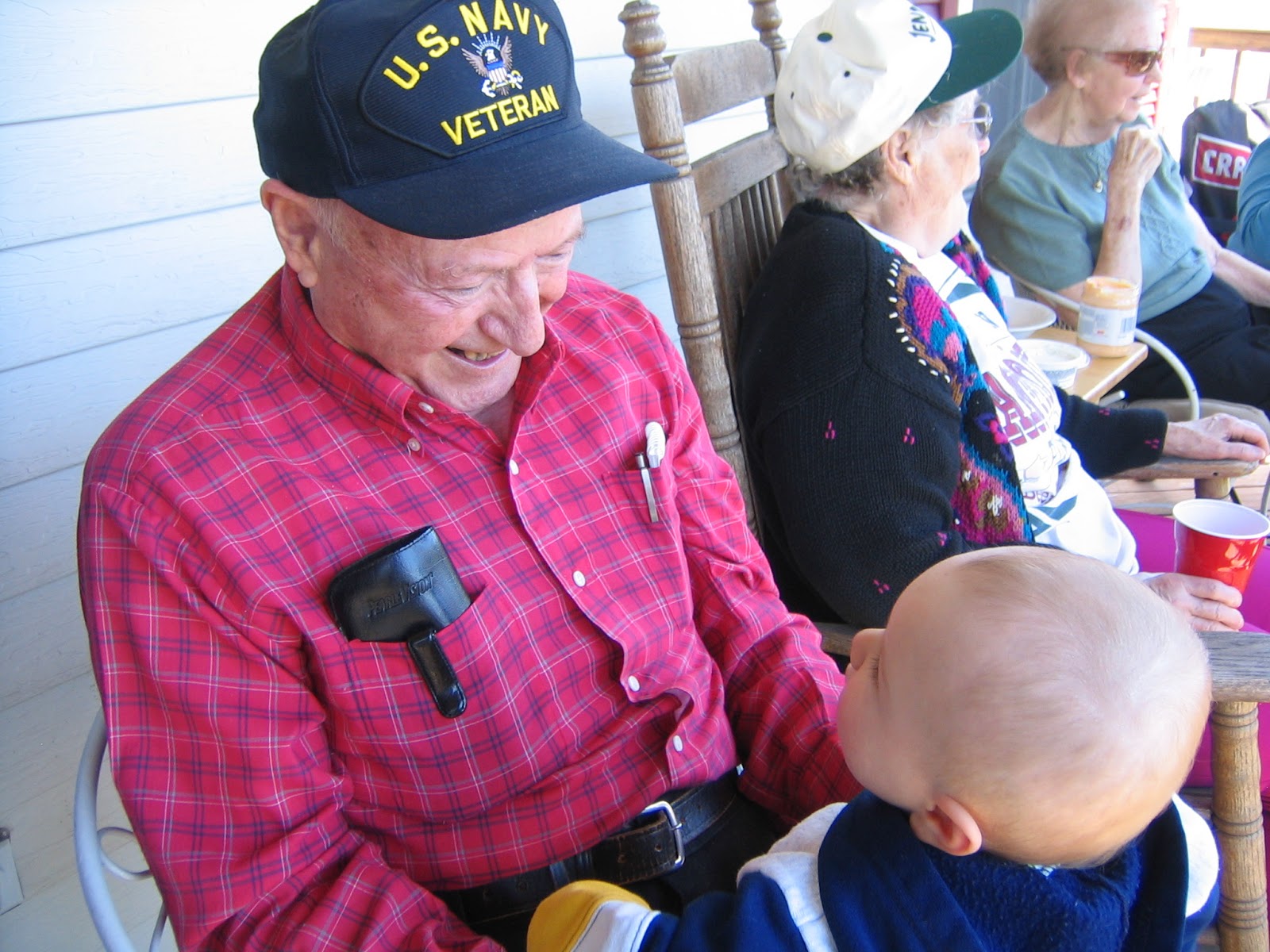
I also wanted to record Norman’s own life story.  So shortly after Veteran’s Day 2008 I phoned him and said, “When I am in Michigan on Thanksgiving weekend, let’s talk about your time in the Navy during WWII.”  He happily consented. 

Little did I know that this would be the last time I ever talked to him...  On the day before Thanksgiving in 2008, he was out on his beloved John Deere tractor, plowing snow out of his driveway, when a van flew over the hill and hit him.  He was thrown to the ground, breaking more bones than any doctor could count.  His tractor was left in two big pieces on the road.  The doctors kept him alive until we could rush to Michigan to say goodbye, and then he was gone.

Later that weekend, when we returned to Norman’s home before the funeral, there on a table in the living room was a neat pile of pictures and documents—the things that Norman had gathered together to share with me about his time in the Navy.  I did write up the history of his time in the Navy, but I had to do it without him; perhaps I’ll share it another day. 

I was never able to find any more photos of Norman’s mother Eliza, but I’m still researching his family’s history.  I’ve learned so much since then, that I wish I could share with him!  I still do Mosey/Carriveau genealogy—For the Love of Norman.