Showing posts with label genealogy. Show all posts

Monday, March 24, 2014

The Grumpy Genealogist


I try to be a cheerful and upbeat genealogist—but once in a while, even a real peach of a human being like myself just has to let off some steam.  Lately, four old and familiar issues in particular are really getting on my nerves, genealogically speaking…

1.     The missing 1890 census.  Honestly, nearly an entire census lost?  How did this happen?  In all the United States of America in 1921, from sea to shining sea, there wasn’t one safe and fire-resistant building with a fireproof vault in which they could store the census records?  It wasn’t worth the price of one night watchman to make sure everything was okay?  And the worst part of it is, I’ve read that most of the records survived the fire (with water damage)—and they were kept for many years, while discussions went on about what to do next, before someone decided one day that the best thing to do was to just throw them all away.  Incredible!  When I think of all the loose ends I could tie up, all the mysteries I could solve, all the gaps I could fill in…  all those missing children…  sigh…


2.     Those blurry, badly microfilmed World War I draft cards.  I’ve read that after the cards were microfilmed (obviously by workers who were either legally blind or looking out the window most of the time), the original cards were discarded.  They threw them away!  Without anyone checking to see if the microfilm images were properly done before destroying the originals?  What I would like to know is this:  Who was the clueless government bureaucrat who made that decision?  I think his/her name should live on in infamy, like the person who threw away the damaged 1890 census.   

3.     Census takers with bad penmanship. Seriously, who was the genius who came up with the guidelines for selecting these people?  Did they not have to give a handwriting sample, perhaps write down a practice family or two?  I would think the ability to write legibly would have been a primary requirement for the job of census taker, but apparently no one thought of that during the hiring process.  I suppose some of the census takers just got sloppy as time went on and didn’t care anymore.  Or maybe some of them got hired because they were some politician’s nephew—I suppose then as now, when it comes to obtaining gainful employment, it isn’t always what you know, it’s who you know.

4.     Relatives who say “I really don’t have anything to share” when it’s pretty obvious that they do.  In this day and age of cheap Priority Mail and FedEx shipping, and scanners in practically every genealogist’s home or office, there’s no excuse for not sharing what we’ve got...  (Calm down, Aunt Emma, I’m not asking you to give it to me, just loan it to me!)  Yet I’ve had to ask some relatives five or six times, over a period of years, if I could borrow their box of family photos or papers.  Some are just too lazy to take the box down out of the attic or dig it out of the guest room closet, but some seem to be exhibiting strange territorial behavior.  Most eventually say yes—but a few hold out, as if “whoever dies with the most stuff wins.”  But everyone ends up losing that game.


Well, thanks for letting me vent…  What makes you do the “Silent Genealogist Scream”?


Tuesday, January 7, 2014

This Genealogist's New Year's Resolutions for 2014


Another new year, full of hopes and dreams, and a few New Year’s Resolutions of a genealogical nature…

1.     Reading:  I want to read a dozen genealogy books in 2014.  One at the top of my list, when I have a little money to spend, is Professional Genealogy edited by Elizabeth Shown Mills, which is a collection of wonderful articles written by a number of genealogy experts.  Not every section would apply to me, but enough of them would.  I want to read Ancestral Trails by Mark D. Herber, which I’ve had on my bookshelf for a while, and which I hope can help me in my search for my husband’s Yorkshire roots.  Also on my list are couple of Christmas gifts from my wonderful step-kids:  Time Traveller’s Handbook: A Guide to the Past by Althea Douglas, for some historical context for my research, and Turn Your iPad into a Genealogy Powerhouse by Lisa Louise Cooke. 

2.     Message Boards:  I have had some wonderful breakthroughs by posting on genealogy message boards, mainly on ancestry.com.  This year I want to use the message boards more often and sooner.  There are some amazing researchers lurking on those boards, ready to take on someone else’s research challenges just for the fun of it.  They think of things I haven’t thought of, and look in places I haven’t looked.

3.     Giving Back:  I have an iphone now, and I want to use it to take photos for billiongraves.com in small cemeteries near my home, and in Amish Indiana when we visit.  I’ll try to do six cemeteries this year, walking the entire cemetery each time.

4.     Giving Back Some More:  I also have made it a habit lately, when I’m bored or can’t sleep, to transcribe gravestones online for billiongraves.com.  The website keeps a count at the top of the page of how many I’ve done…  I’ve transcribed about 750 at last count.  I’ll try to do at least 100 transcriptions a month.  I love findagrave.com and I use it all the time—I’ve contributed to it, and no doubt will again—but I think billiongraves.com is the wave of the future.

5.     Photographs:  In my never-ending search for photographs of my family and my husband’s family to add to my collection (and share with others), I’ll reach out to a few more distant and newly-discovered cousins this year—sharing what I have if they’ll do the same.  I have thousands of photos already, but the next exciting discovery is always around the corner!  Share, share, share—that’s the way to keep these photos from disappearing into the mists of time (or into someone’s closet or fried hard drive).

6.     Blogs:  I love to write posts for my genealogy blog, but this year I’m going to read more of other people’s blogs.  The only one to which I actually subscribe is Judy Russell’s blog, “The Legal Genealogist.”  I’m going to add a few more.  There are a lot of well-written ones out there, and it’s good reading when I have a few minutes to spare.

7.     A Field Trip:  Fort Wayne, Indiana isn’t that far away, and we travel to Northeastern Indiana regularly…  Maybe this will be the year I can visit the Allen County Public Library’s nationally famous Genealogy Center for the first time.  I’ve been told that it’s one of the finest genealogy libraries in the entire country.  We intend to retire to Northeastern Indiana in a few years, but I hope I don’t have to wait that long to check out this wonderful place that I’ve heard so much about! 


So that’s the plan, anyway.

Thursday, November 21, 2013

Thankful Thursday: My Ten Favorite Posts from Year One


It was a year ago that I started blogging.  I hoped to share the stories I’ve discovered in researching my own family and the families of friends and clients.  I was afraid I’d run out of stories, but that hasn’t happened!  I'm thankful for the stories I've discovered and the people I've met (both dead and alive).  Here are ten of my favorite stories from Year One:

For the Love of Norman – This was my very first post.  It was about the brief time I was privileged to know my father-in-law, and our quest to learn more about his past.

A Young Man With a Past – This is the story of a young man my husband worked with, whose genealogy turned up an amazing heritage that neither of us expected.

Genealogy and Alzheimer’s – The story of a discovery I made with the help of a client, whose mother-in-law has dementia but really enjoyed learning about her ancestry.

Anna Peterson Genoways: Love Found Late – This is a love story about one of my grandmother’s sisters, and it has a bittersweet ending.

Double Wedding Ring – This love story from my sister-in-law’s family, about a woman named Rhoda Wyatt who lived in the 1800s, had a much happier ending.

Lutefisk: Scourge of the Scandinavians – My feelings about a Swedish tradition from my childhood that I could easily have lived without.

George Wendell Phillips: Gone Without a Trace – This is a mystery from a client’s family history that, with the help of my readers, I was able to solve.

What Ever Happened to Agnes Goldberger? – This is a mystery that I still haven’t been able to solve.  It concerns a foster child raised alongside my mother who left their family when she was about sixteen and was never heard from again.

“La Corriveau” – I do love the black sheep stories!  This one is about one of the most infamous murderers in Canadian history—who also happens to be my husband’s second cousin, six times removed.

A Murder in Chicago – One more black sheep story for good measure.  This one tells the story of a love triangle in my sister-in-law Susie’s family that ended with her great-great-aunt being murdered.


And so Year Two begins.

Tuesday, September 24, 2013

My Graveyard Kit


Is it weird that I have a graveyard kit?  How else can you go grave hunting in an organized and well-equipped manner?  Mine is stored in a pink bucket with a decal on it.  (I’m a very girly grave hunter.)

The bucket contains all the stuff I need for proper gravestone hunting (except a goodly supply of water—never leave home without a goodly supply of water).  The bucket contains:
  • A notebook and a pen, along with any information that I had the foresight to gather together beforehand.
  • My camera, of course.  How else can I take photos to upload to findagrave.com?
  • A little pink flashlight, for casting shadows on gravestones for better pictures.  The experts advise a big mirror for that purpose, but that won’t fit into my bucket.
  • Grass snips, a trowel, and a whisk broom, for quick cleanup work as required.
  • Cotton gloves.
  • A second bucket just like the first one, for hauling water if there’s a faucet.  (But I learned the hard way to also bring plenty of gallon jugs of water, especially when going to very old or abandoned cemeteries.)
  • A stiff-but-soft scrub brush that fits well into my husband’s hand.
  • Liquid soap—a special kind.  (I did a lot of research on this subject.)  It’s called “Orvus” and it has three main uses, so I’m told:  Washing horses, washing antique fabrics, and washing gravestones.  Fancy that!…
  • Wet wipes.  I like having clean hands when I use my camera (and all the rest of the time, too, actually).
  • A big Ziploc bag, for kneeling upon to take photographs.  I don’t like dirty knees either.
  • Bug repellent.  I once went wandering through some tall grass in the woods in cropped pants, looking for a few old gravestones which made up a small old family cemetery...  I came out with about a hundred bug bites on my lower legs.  I’m lucky I didn’t end up with Lyme disease!
  • White chalk for marking trees and driveways for navigational purposes.  Don’t want to walk the same rows twice if I don’t have to.
  • Little American flags.  I like to leave them at the graves of veterans.

Okay, so is this normal, or weird?  All genealogists love graveyards, right?  I once saw a coffee mug for genealogists that said, “I’m only interested in dead people.”  Well, yes, but I wouldn’t say only…  

Monday, April 8, 2013

Why Learn About Your Family History?


“Trees without roots fall over.”—anonymous

My husband isn’t interested in genealogy. He tries hard—but if I go on about it for more than a minute or two, his eyes glaze over. It seems that people are either very interested in genealogy, or not interested at all. For those who are—but who are not natural-born researchers equipped with mad computer skills, endless hours at their disposal to learn the tricks of the trade, and $300 to spend on a subscription to ancestry.com—and if no one in the family has done the work, or if they had, it’s in a dusty old folder and it’s impossible to figure out, let alone enjoy—why pay someone to research one’s family history?

First: To honor those who came before.
My ancestors were a mixture of heroes and black sheep and ordinary people. But I don’t want any of their stories to be lost. The matriarchs and patriarchs, the babies who died, and all those in the middle—they were real people, and their blood runs through my veins.

Second: To preserve your family story for those who will come after.
Interest in genealogy seems to skip a generation in some families. I sent ancestry binders to nine of my cousins for Christmas a few years ago. One cousin didn’t even acknowledge receiving it—but I later heard that his daughter thought it was the best thing ever. You just never know.

Third: To understand yourself better.
Are your children anything like you? Are you anything like your parents? Blood really is thicker than water, and when you look at your family’s past, you might be surprised at what looks back at you. A few years ago I went to Sweden, and as I looked around, I realized that the men all looked like my father! But you don’t have to cross an ocean to have those moments. A photo, a story, a surprising discovery about an ancestor’s life, can make you feel like a part of something bigger than yourself.

Fourth: To bring family together through their shared history.
Some of my best interactions with my cousins and aunts have been over genealogy. They may not all be interested in everyone or everything, but most of them are interested in someone or something! And I’m surprised how often they have something to share—a story, a document, a photo, a family artifact, or a question that puts me on a whole new path of research. And for the elderly suffering from memory loss, the memories from long ago are the last to fade. They may not remember their grandchildren’s names, but they remember their grandparents’ names.

If you have always wondered about your roots, then remember this: The longer you wait, as your grandparents, aunts and uncles, and parents pass away (and their belongings are scattered), the more of your history will fade into the mist. Find out what you can from those who are still alive. Look around your house or theirs and see what has survived. And take that step—what do you have to lose?

Monday, November 19, 2012

Grandma Wallin—Ahead of Her Time

My paternal grandmother was Sara Elizabeth Peterson Wallin, whose father Charles Peterson I will write about in a future post.  It was Grandma Wallin who gave me my love of genealogy (and some of my Swedish genes).


Grandma was born in Nebraska in 1894 and died nearly 100 years later, in 1986.  She grew up at a time when girls, especially daughters of immigrants on the Nebraska prairie, didn’t think about much except getting married and having a family.  But Grandma was smarter than most, and more ambitious than most.  She managed, after graduating eighth grade, to attend a nearby coed ‘college’ (as the word was used then), Luther College, and then get a job at a local bank, the Hordville Bank.  She did well there—well enough that when the owner/president of the bank needed to be out of town, Sara ran the bank.  But when WWI ended and her sweetheart came home from France, she gladly gave that up and settled down.  She and Sture Nels Wallin were married in 1920, after a seven-year-long courtship. 

When I knew her, half a century later, she was interested in genealogy, and it rubbed off on me.  I spent a few happy afternoons in my childhood walking around a local cemetery with her, reading each gravestone and imagining the lives of those they described.  I still remember her handwritten charts showing her ancestry and Grandpa’s.  I ended up with that information in later years, and it became the basis of a family tree that now has nearly 10,000 members on it. 

But what I remember most about Grandma Wallin was her insistence that all her grandchildren, girls included, should try to get an education.  (That, and the lutefisk I avoided like the plague every Christmastime.)

So thank you for the inspiration, Grandma Wallin.  You are gone but not forgotten!

Sunday, November 18, 2012

For the Love of Norman


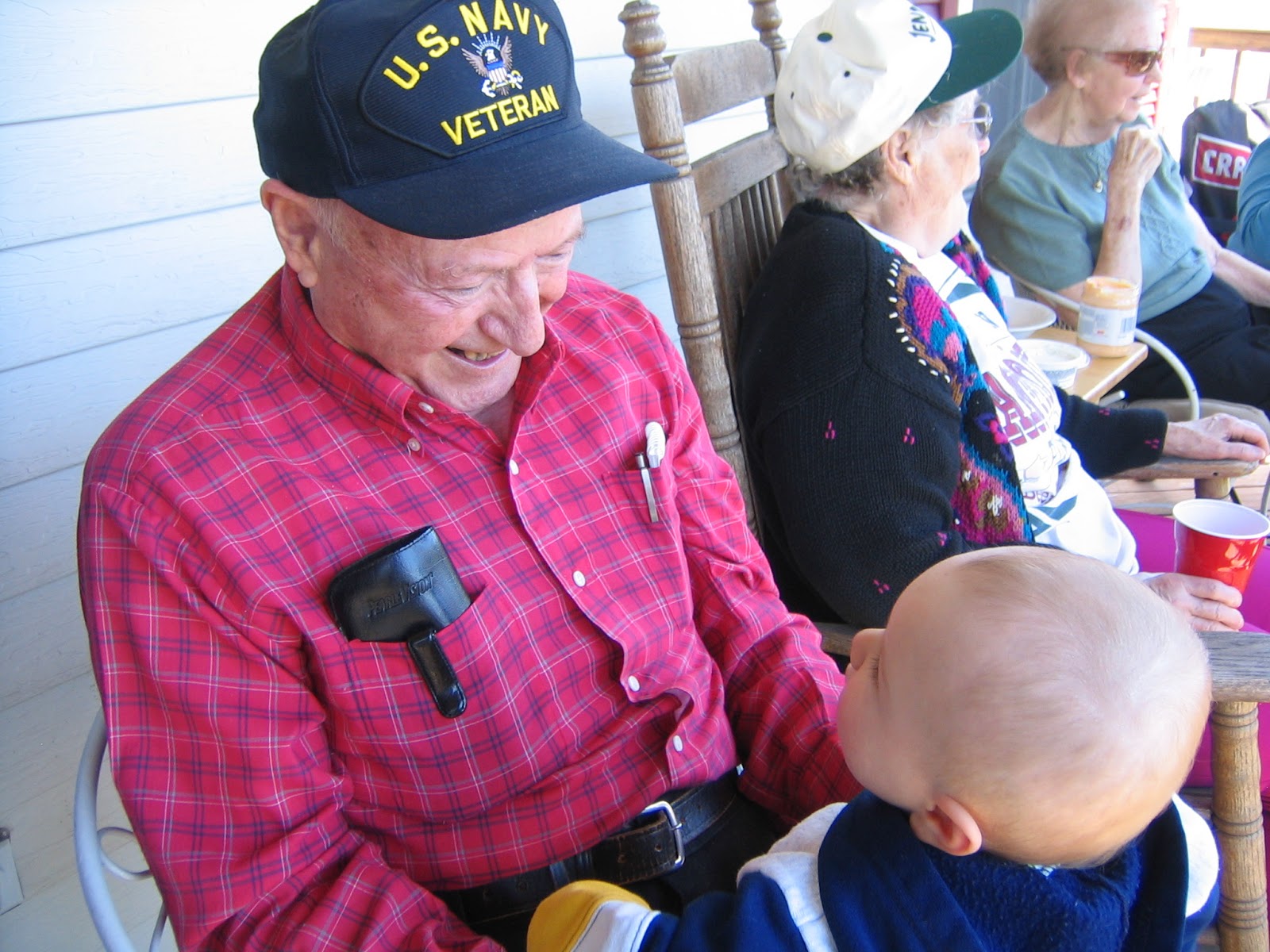
I was married for the first time in 2007 at age 51, to a wonderful man.  His father, Norman, walked me down the aisle that day, since my father had died many years before.  As I got to know Norman, I was intrigued by the story of his mother, Eliza Jane Carriveau Mosey, who had died tragically when Norman was five.  Norman had only one picture of her—her wedding picture—and knew very little about her, since his father had remained a stoic and grieving widower for the rest of his life.


I had been a genealogy buff for a long time by then.  So Norman and I began looking at his ancestry, trying to find out more about his mother and her family.  We spent many happy hours around his kitchen table that first year, poring over documents and talking and taking notes.  Slowly the story of the Carriveaus started coming together. 

I also wanted to record Norman’s own life story.  So shortly after Veteran’s Day 2008 I phoned him and said, “When I am in Michigan on Thanksgiving weekend, let’s talk about your time in the Navy during WWII.”  He happily consented. 

Little did I know that this would be the last time I ever talked to him...  On the day before Thanksgiving in 2008, he was out on his beloved John Deere tractor, plowing snow out of his driveway, when a van flew over the hill and hit him.  He was thrown to the ground, breaking more bones than any doctor could count.  His tractor was left in two big pieces on the road.  The doctors kept him alive until we could rush to Michigan to say goodbye, and then he was gone.

Later that weekend, when we returned to Norman’s home before the funeral, there on a table in the living room was a neat pile of pictures and documents—the things that Norman had gathered together to share with me about his time in the Navy.  I did write up the history of his time in the Navy, but I had to do it without him; perhaps I’ll share it another day. 

I was never able to find any more photos of Norman’s mother Eliza, but I’m still researching his family’s history.  I’ve learned so much since then, that I wish I could share with him!  I still do Mosey/Carriveau genealogy—For the Love of Norman.