Showing posts with label soldier. Show all posts

Monday, December 8, 2014

A Young Soldier's "Personal Affairs"


After my father’s death in 1993, my sister and I sat on the floor of the living room one evening, going through boxes and drawers of his military papers, deciding what to keep.  We found a booklet entitled “Personal Affairs of Military Personnel and Dependents”—this is the front cover.  There are some notes in my father’s handwriting, which read as follows:

“Note:  In [the] event of my untimely demise, Be sure to collect these 4:

1.  Insurance,

2.  6 months gratuity ($900) lump sum;

3.  My back accrued pay.  (2. and 3. Not automatic—action must be initiated by you.  See inside of book for details.)

4.  Grab my money out of the bank (using enclosed power of attorney) before they freeze it.  The enclosed Power of Attorney lasts no longer than I do, but if you get it out before they know I’m gone, it will save trouble.  Otherwise file my will and they will come across.

This book will answer a lot of questions.”

I guess this is consistent with the fact that Dad was a business major in college before the war!  

The booklet had three pages of information about his final wishes and was meant to be left with his next of kin—in his case, his mother.  In my imagination I am picturing a roomful of recruits, headed for overseas, sitting at tables and filling in this booklet, thinking about their own deaths possibly for the first time, as it sunk in that yes, they were headed for the front lines of what we now call World War Two and might never return.

Page 1 gives basic information, including that he is 21 years old.  He carries $10,000 of life insurance, payable to his mother Sara, with his father as Contingent Beneficiary.  (That’s the equivalent of about $133,000 today.)  This optional insurance cost him $6.50 a month out of his pay—but his parents were not well off financially, and that money would have meant a lot to them—a chance to buy their own farm instead of renting, for example.

From his army pay of $150 per month (about $2,000 today), he had $50 a month sent to his bank at home, and another $18.75 taken out to buy War Bonds.  The booklet said, “If I am reported missing, missing in action, interned in a neutral country, or captured or besieged by enemy forces, the allotments out of my pay for insurance and support of my relatives will be paid by the government for 12 months.”

Page 1 of the form goes on to say that Dad had executed a will and Power of Attorney and mailed them to his father in Big Rock, Illinois.

Page 2 has blanks to fill in where he might have a Safe Deposit Box, where he left personal papers, and what debts he owed (none).  Then it says, “If I die in the line of duty, from wounds, or illness, or other causes, I have designated [here he filled in his mother’s name] as a dependent to receive  the six months’ gratuity pay awarded by the government.”  Dad hand-write off to the side, “$900.”  It then had a place for the soldier to list where they had bank accounts. 

Page 3 gets even more “real.”  It says, “I desire that my permanent place of burial be at ________.”  (Dad wrote in, “No Preference.”)  It goes on to say, “If I die abroad, my remains will be returned to the United States by the Government after the War, but not earlier.”  It goes on to give other instructions to the family as to how to retrieve the body and receive funds for burial expenses and a possible pension.  Copies of any marriage records and birth certificates of children are then asked for.


In the photo, taken at his parents’ new home in Big Rock, Illinois before he went overseas, Dad (far right) is posing with his father, little brother Richard, little sister Janet, and mother.   Perhaps his sister Helen is the one taking the picture.  He was just twenty years old when he was drafted—barely out of his teens—but forced to think about “the event of his untimely demise.”

Monday, December 1, 2014

Forgiveness and Friendship

I have written quite a bit about my father and his service in the U.S. Army in World War II.  This story took place a few years later.

After the war, my father was required to be in the U.S. Army Reserves for a number of years, and go to training camp for a few weeks in the summer.  In fact, he once told me that he very nearly ended up in the Korean War—but his card didn’t get chosen during the random drawing of one in three cards in the file. 


In the late 1940s he met my mother, Adra, and they were married in 1950.  They moved into an apartment at 620 Archer Avenue in Aurora—the downstairs of an old white frame house which has since been torn down.  (The first photo shows Robert and Adra on the front porch.)  Both had jobs within walking distance—Dad at a steel storage company called Equipto, and Mom at another steel storage company down the street called All-Steel.  


Into the upstairs apartment moved a young married couple very much like themselves—but yet so different.  Hartwig and Frieda were recent immigrants; they had arrived in the U.S. from Austria in 1952.  The 1930s had been a bad time to be a young man in Austria.  Hartwig, being five years younger than my father and therefore too young to be drafted into Hitler’s Army, ended up in an organization called the Hitler Youth.  He would have been 15 years old when Hitler invaded Poland in 1939.

I wanted to find out more about being a young person in Nazi Germany and Austria.  I found this quote from Adolf Hitler on the History Learning Site.  He said this of German schoolchildren:  “The weak must be chiselled away.  I want young men and women who can suffer pain.  A young German must be as swift as a greyhound, as tough as leather, and as hard as Krupp's steel.”

The U.S. Holocaust Museum website had this quote: 

“These boys and girls enter our organizations at ten years of age, and often for the first time get a little fresh air; after four years of the Young Folk they go on to the Hitler Youth, where we have them for another four years… And even if they are still not complete National Socialists [Nazis], they go to Labor Service and are smoothed out there for another six, seven months…  And whatever class consciousness or social status might still be left…  the Wehrmacht [German armed forces] will take care of that.”—Adolf Hitler (1938)

But back to my story:  Hartwig and Frieda moved into the apartment above my parents.  This would have been in the early 1950s.  Even in my childhood in the 1960s, my father still referred to the Germans as “Krauts”—an old habit that died hard, after spending a year of his life on the front lines shooting Germans at every opportunity and in nearly continual fear for his life.  Dad continued to have nightmares about the war for twenty years after he came home.

But somehow, the two couples ended up friends.  I wonder if they ever talked about the war, or Hitler, or what it was like in Austria in the 1940s?  I don’t know.  I do know that Hartwig worked as a night watchman in a nearby factory, while he taught himself English and studied engineering books.  Eventually he got a better job there as a spot welder, then a maintenance electrician, then a mechanic, and then an engineer.  He and Frieda had four children and had a good life in America.

But more importantly to this story—Hartwig and Frieda wanted to put their past behind them and become American citizens.  To do that, they needed American citizens to be their sponsors.  And who were the sponsors for Hartwig and Frieda?  My parents.

I remember, even after each couple purchased their own home in the later 1950s, my father and I dropping by their home or Hartwig dropping by ours.  I am so very glad that those two young couples, in their own small way, were a part of the healing, friendship, and forgiveness that needed to take place after one of the worst wars in modern history. 


Monday, November 10, 2014

The Fire


This photograph shows one of the papers from my father’s WWII military file.  I include it here not because of its great importance in the story of his military career—but rather, for the burn marks around the edges.  Anyone who has done (or tried to do) research on a WWI or WWII military ancestor may know where those burn marks came from.

My father, Robert Wallin, told me many stories about his time in WWII, and I have his letters home to tell me more.  Like countless aging baby boomers with fathers who fought in the war, I wish I had asked him so much more—and written it all down or recorded it.  So a few years back, I decided to order his military records from the National Archives.

My father was in the Army, so his records are found at the National Personnel Records Center (NPRC) in St. Louis, Missouri.  (Navy records are stored elsewhere.)  Unfortunately, the NPRC had a catastrophic fire on July 12, 1973.  The National Archives website says that 80% of the records were destroyed for Army personnel discharged between 1912 and 1960.  That covers World War One, World War Two, and the Korean War—what an extensive and  devastating loss!  (Many Air Force records were also destroyed.)  No duplicates, microfilm, or other backups were kept.  And since there were no indexes, there isn’t even a good listing of what was lost.


 I found out more on the Stars and Stripes website.  The fire started on the sixth floor of the building in the middle of the night; no cause was ever determined.  It burned out of control for 22 hours as 43 fire departments battled it.  It took 4½ days and millions of gallons of water before the fire department declared the fire extinguished.  The sixth floor was destroyed, and the records on the floors below were soaked with water.  The records of 18 million veterans were lost.

About 6.5 million partially burned, water-soaked personnel files were salvaged.  Over forty years later, preservation specialists are still working on restoring them.  It takes the equivalent of 30 full-time employees to respond to the requests of those, like me, who are looking for records from the damaged collection.  Of the 5,000 requests per day that the NPRC receives, they estimate that about 200-300 are for those damaged records.  Those requests go to the specialists at the Paper Treatment Lab, who call the burned records the “B-Files.” 

After the fire, the B-Files were taken to the vacuum-drying chamber at the nearby McDonnell-Douglas aircraft facilities.  The vacuum chamber, which was built to train Mercury and Gemini space program astronauts, was now put into service in taking 8 tons of water out of each 2,000 milk-crate-sized containers of wet documents which the chamber could handle per drying session.  The files were then indexed and stored, to be handled again only if a document request is received.

I was fortunate that my father’s military and medical records (which were extensive) survived the fire—although barely, as the photo shows.  Some had burn marks and some had water damage stains, but at least I received the file.  The records for my grandfather, Sture Wallin, who served in World War One, are entirely gone, so I was told in a letter from the NPRC.  To my knowledge, no one in the family recorded any details whatsoever of Grandpa Wallin’s service, and no papers have survived.  Gone forever.

The MissouriNet website says that, incredibly, the NPRC continued to use the old building until 2012!  The NPRC “now has a new state-of-the-art building with some serious ways to prevent a fire from destroying national records.”  Thank goodness for that.


NPRC building photo:  National Archives

Monday, November 3, 2014

A Dad and a Hero


This paper from my father’s military file tells the story of something he did in March 1945.  (I will tell the story of the burn marks on his records in another post.)

The paper reads as follows:

“First Lieutenant Robert M. Wallin, 0538229, 120th Infantry Regiment, United States Army, is awarded the Bronze Star for heroic achievement in action on 26 March 1945, in Germany.  Although enemy fire was so intense that it killed one man and wounded eight others, Lieutenant Wallin and his comrades left their sheltered positions and exposed themselves to enemy fire to evacuate three of the men to the rear where they received medical attention.  By his heroic action, Lieutenant Wallin aided in saving the lives of his comrades.
[Entered military service from Illinois.]
 
L.S. Hobbs, Major General – U.S. Army Commanding”

The amazing thing is this:  Dad had just spent five months in a military hospital recovering from serious injuries sustained on the front lines the previous October.  So it’s certainly not like he thought he was invincible…  And how could he?  He had seen more horror and death by this time than anyone should have to see—stories he told me late at night when I was growing up…  Stories of comrades dying in ways I can only hope their families never knew.  Dad’s very first day in combat, his closest friend in the unit was blown up and dismembered, and Dad had to gather the pieces and lay them with the man’s dog tags.

According to my father, stories like what happened the day he got the Bronze Star weren’t that rare.  What was rare was having a superior officer see or find out what happened, and then take the time to write it up.  Just from the few stories Dad told me late at night, I know of at least two other times where he was in this much danger.

One of them was a situation similar to this one.  Dad (a platoon leader) told me that one of his men was badly wounded during a battle.  Dad crawled across a field to the man, and realized right away that if he had run across the field standing up, he probably wouldn’t have lived to tell the story.  He had a struggle of conscience as to what to do…  The man had both a broken arm and a broken leg, so he would have to be carried back across the field, through enemy fire—and it looked like the man outweighed Dad by fifty pounds.

Dad asked the man, “Do you have a family?” and the man answered, “Yeah, a wife and three kids.”  Dad told me he remembered saying to himself something like, “Oh, crap!”—knowing what it was he thought he should do, but not wanting to do it.  But he hoisted the man onto his shoulders and staggered back across the field.  Both of them made it back alive.

In the case of the Bronze Star story, it was Dad and several comrades who evacuated three men.  We’ve all heard the motto of “no man left behind,” but it’s still incredible that young soldiers can summon up such courage in the face of such danger. 

If my father and his comrades hadn’t made it back to their “sheltered positions” alive that day, I wouldn’t be here today.  But because they did, three other men went home to quite possibly have children of their own as well—perhaps even someone who is reading this story today.

Monday, March 17, 2014

Military Monday: Jacob Heilman


My husband’s mother has three great-grandfathers who served in the Civil War.  One died (Charles Alwood, whom I wrote about previously), and two others survived.  One of those who survived was Jacob Heilman.

Jacob was born in Bavaria in 1819 and came to the United States in 1844, according to a book of historical sketches published in 1976 by the Henry County, Ohio Historical Society.  (A New York Passenger list I found supports this.)  He came to Ohio in 1847 with a brother and married Maria Baker there in 1850.  They had twelve children—four sons and eight daughters—eight of whom survived him. 


According to his service record on ancestry.com, Jacob was a Private in Company F of the Ohio 68th Infantry Regiment, and his grave marker confirms that fact.  He would have been in his forties at the time—not a young man!  It was said that his unit marched over 7,000 miles and rode trains or steamboats another 6,000 miles, and that his regiment was in every Confederate state except Florida and Texas.    

There are good histories of his unit, and they bear this out.  I consulted “Dyer’s Compendium” online and got some details.  The 68th started out at the Battle of Fort Donelson and took part in nearly every major battle and siege of the war, including the Battle of Shiloh, the siege of Vicksburg, and Sherman’s March to Atlanta.  The regiment lost two officers and 48 enlisted men in battle, and another one officer and 249 enlisted men to disease, for a total of 300 deaths.

The actual dates of Jacob’s service are sketchy.  The 1975 biographical sketch (written by Jacob’s great-grandson Lyle Heilman) says that Jacob enlisted in 1861 when the war broke out and served until the war was over.  Maria had a daughter in May 1862, but the baby could have been born after Jacob left for the war.  Dyer’s history shows that his unit had a long furlough in early 1864—but judging by the birth date of Jacob’s son John (June 1864), Jacob was home by September 1863.  A draft register listing him as “discharged” in June 1863 bears that out.  So the extent of action Jacob actually saw is uncertain—but whatever his length of service, it was enough for Jacob to apply for, and receive, an Civil War veteran invalid pension in March 1873. 

It is said in the family that he was blind the last twelve years of his life; he died in 1907, with his wife following in 1912.

I found Jacob’s grave a few years ago at Florida Cemetery in Henry County, Ohio.  My husband and I put a flag on it before taking a photograph.  I was pleased to see the G.A.R. marker there.  In an original photo of him which survives, and which I was fortunate enough to borrow from my husband’s cousin Dale Garver, even in his old age Jacob looks brave and strong—a survivor. 


Monday, February 24, 2014

Ezra Alger, Prisoner at Andersonville

George, an old friend of my husband’s, lost his father when he was just a teenager.  He wanted to know more about his father’s family history and I offered my help.  Going back a few generations, I found the story of Ezra Alger, who fought in the Union Army during the Civil War.


Private Ezra B. Alger was a member of Company I of the 7th New York Artillery, enlisting on December 16, 1863 in Hudson, New York.  According to the New York State Military Museum website, the 7th New York Artillery Regiment fought at Spotsylvania Court House, North Anna River, and Totopotomoy Creek, Virginia in May of 1864, suffering over 200 casualties during that month.

The 7th then fought at the Battle of Cold Harbor, Virginia from June 1-12, 1864.  They suffered 418 casualties there, either killed, wounded, or missing in action—including Ezra Alger.  He was captured by the enemy on June 3, 1864 and was sent to the infamous Andersonville Prison at Andersonville, Georgia.

Andersonville is now a National Historic Site with a huge military cemetery.  According to wikipedia.com, about 45,000 Union prisoners were kept on its 26.5 acres, and nearly 13,000 of them died of starvation and disease and were buried there.  One Union soldier described arriving there like this:  “As we entered the place, a spectacle met our eyes that almost froze our blood with horror… Before us were forms that had once been… stalwart men, now nothing but mere walking skeletons, covered with filth and vermin.  Many of our men, in the heat and intensity of  their feeling, exclaimed, ‘Can this be hell?’”

Wikipedia goes on to say that Andersonville was frequently undersupplied with food, and the prisoners suffered from hunger, exposure, and disease.  The water supply was polluted due to overcrowding and poor sanitation, and the desperate conditions made some of the men turn to violent infighting. 

In the autumn of 1864 after the capture of Atlanta, the surviving prisoners were taken to other, better prison camps, but it was too late for Ezra Alger.  He never came home, and was reported to have died at Andersonville.

Ezra, who was a shoemaker, left a widow and ten children.  In the 1870 federal census for Cohoes, Albany County, New York, his widow lives with nine of their children, and the six oldest work in a cotton mill—the youngest worker being only eleven years old.  In 1880 she is a housekeeper and six of her children still live with her, all working to support the family.  She died in 1888 at age sixty.

Historians are still arguing as to whether the high number of deaths at Andersonville were a result of incompetent prison officials, the general food shortages in the Confederate states, deliberate war crimes, or bad Confederate government policies.  But at any rate, the commandant of the camp, Henry Wirz, was court-martialed and tried for conspiracy and murder after the war, found guilty, and hanged—the only Confederate official to be tried and convicted for war crimes.


Monday, February 17, 2014

Sara's Letters to Her Soldier Boy

A few years ago I was able to borrow my grandma Sara Peterson’s letters to her sweetheart and future husband, Sture Wallin, written while he was in the army during WWI and she worked at a bank at home in Nebraska.  Here are some excerpts:


“Honestly, Sture, I just can’t get to feeling enthusiastic about my job down here—and if one doesn’t like your work, what is there to it?  I’d be ready to leave tomorrow—if it wasn’t war times…  Help is so scarce.  I ought to be glad I can do something, even if I don’t like it.”

“Don’t know if we can send a Christmas package.  Of course I can see where with between 1-2 million soldiers in France and everybody wanting to send them something they have to have a limit.  But I feel you are the only ones that need Christmas presents this year.”

“Dear, though I was glad as long as you were in this country, I’m glad you got your chance to go across, when you have been waiting to go for so long.  I wonder where you are—somewhere on the Atlantic.  But you must be almost across by this time...”

“Just as I got through writing the other letter to you, one of the men came in with the mail.  “Did I want a letter from overseas?” he asked.  Did I!  I’d had that letter if I’d had to knock him down to get it.  This was the first letter you had written—dated November 3.  So you did really get to France.  You can think that at least if you can’t be home this Christmas, next Christmas we’ll be sure to see you back here.”

The war ended before Sture saw any action.  But it was eight more months before he came home.

“Seems rather quiet in town today after all the excitement of yesterday.  The message came over the wires yesterday noon that Germany had surrendered.  Of course the town went wild and I guess they did all over the U.S.  They had parades and bands and the home guards out…” 

“News came this week of the death of Ernest Post.  Also James Richardson.  Also a couple of Aurora boys.  Seems so terrible at this time.  The people here all have been rejoicing at the thought of it all being ended.  But so many never gave a thought to that the casualty lists would be coming in for weeks.”

“Christmas Eve!  And such a way to spend it!  My soldier boy way across the Atlantic in France.  If I could see your dear face tonight, this would be a truly wonderful Christmas after all.  I’ve got your picture up on my dresser where I can look at it all the time... ”

“I found the place you were before on the map yesterday.  You were quite a way in France, weren’t you?  And not so far from Paris.  Perhaps you’ll have a chance to go there before you come back.”

“Do you think you will be back with the rest of Co. H?  Each of the boys that write back home seem to have a different opinion as to when they will be sent back.  They surely are sending them right along, but 2 some million are quite a few men and it took Uncle Sam several months to send them over and I guess ‘twill take just as long to come back.”

“Don’t think I’ve changed a great deal as to outward appearances.  I know I have otherwise.  What the last two years brought certainly would make some difference…” 

“The other Co. H boys came home 2 weeks ago…  Elmer said it took them 12 days to come across.  In that case if you left June 20th you would be in NY about July 2nd…  Just now all I can think of is that you will soon be here.  And I can’t tell you in words what that all means to me.  I’ll be the happiest girl in the world when you come back.”


Monday, February 3, 2014

A Civil War Widow Applies for a Pension

Recently my fold3.com subscription was about to expire.  I rarely used it, finding it hard to navigate and not very useful.  But I decided to give it one last chance to prove itself.  

I started poking around the Civil War records, since that’s their specialty.  After a few misses, I had a hit.  My husband’s great-great-grandfather Charles Alwood, who died in a Civil War camp from typhoid fever, had a wife who applied for a widow’s pension just weeks after he died.  I downloaded and printed out the 18 pages of records, and it was a gold mine!


I spent the next few hours analyzing what I’d found.  It included:
  • The Declaration, partially shown in the photo.  It was an sworn affidavit which gave a detailed background of Elizabeth and Charles, his service, his death, and their family.  Her parents were the sworn witnesses.  One thing they had to swear to was that Elizabeth “has not, in any manner, been engaged in, or aided or abetted the rebellion in the United States.”  Elizabeth had to sign all the documents with an “X”—she couldn’t read or write.
  • As proof of these facts, a letter from the Adjutant General’s Office which gave the details of Charles’ army service, from enrollment until death.  Very handy to have!
  • A letter from the Surgeon General’s Office that is the equivalent of a death certificate for Charles.  Priceless!  I’d never been able to narrow down exactly when and where he died.
  • An affidavit from Tuscarawas County, Ohio, stating the details of Charles and Elizabeth’s marriage—the equivalent of a marriage certificate, signed by a judge.
  • An affidavit from Elizabeth’s mother, stating that she was present at the birth of all six underage children being listed on the pension application.  She gave the details about each birth.  A great substitute for official birth records, which the government did not keep in the 1850s!
  • Paperwork for Elizabeth’s later application (and approval) for a pension increase; in addition to her $8 per month, she was entitled to an additional $2 per month for each child under age 16.  The children are again listed, with birth dates and dates on which they will turn 16, along with many other details.
  • A “Drop Pensioner” card which states the details of Elizabeth’s death in 1912, at which time she was receiving $12 a month.  Not a death record, but pretty darn close.  Better than anything I’d been able to find previously.

I found it interesting that, on these forms created in the middle of the Civil War, the conflict is referred to as “The War of 1861.”  I’d never heard it called that before.

So, maybe fold3.com had its place in my toolbox after all...  I have written for a Civil War pension record before—to the National Archives—and it was an expensive hassle.  This was easy and free!  So, I did one more thing that day—I renewed my subscription to fold3.com.

Thursday, November 14, 2013

Treasure Chest Thursday: Dad's War Souvenirs, Part Three

My father, Robert Wallin, fought in the army infantry in World War II, fighting his way—on foot—from Normandy to Germany.  Like many of his fellow soldiers, he brought home a duffel bag of mementoes which, sixty years later and long after his death, are family treasures.

Part Three:  Nazi Souvenirs


The first photo is a belt buckle that my father retrieved from the body of a dead Nazi soldier.  (He brought home a handful of this type of items with the Nazi swastika and eagle on them.)  In a letter home to his parents he said this about how he came into possession of it:  “I have a belt buckle I’m going to send home.  When I do, save it, as I got it in a personal fight with a German sergeant at about 10 paces range and shot him 6 times and cut off his belt buckle and insignia.  Here is the insignia.”   

A similar thing that Dad brought back is a belt buckle that bears the German words “Gott Mit Uns”—which is to say, “God With Us.”


The second item is made of red wool—thus the moth holes it acquired in its half century in my parents’ attic.  It is a Nazi arm band such as I’ve seen in old photographs.  He also managed to bring home a huge Nazi flag, as big as the front side of our house, which he removed from a stadium of some type after the war was over.  I remember his saying that the American troops went door to door, clearing out the Nazi propaganda from each house and making big bonfires of it in the streets.  But a few things ended up in the American soldiers’ duffel bags instead.  Dad said this in a letter home shortly after the Nazi surrender: 

“These Germans are funny.  All of them hate Hitler, and never had anything to do with him, and are glad to see us, etc., etc.  Then we search their houses and drag uniforms, pictures of Hitler, charter membership cards to the Nazi party, and everything else out.  What a bunch of cheerful liars.”


The third item came from the front of a Nazi officer’s hat.  I don’t know the story of how my father came into possession of it, but I think it’s safe to say that its original owner didn’t part with it willingly!

Related posts:
Dad's War Souvenirs, Part One
Dad's War Souvenirs, Part Two
A Big Brother's Urgent Plea
Letters from the Front Lines: Don't Worry, Please

Thursday, November 7, 2013

Treasure Chest Thursday: Dad's War Souvenirs, Part Two

My father, Robert Wallin, fought in the army infantry in World War II, fighting his way—on foot—from Normandy to Germany.  Like many of his fellow soldiers, he brought home a duffel bag of mementoes which, sixty years later and long after his death, are family treasures.

Part Two:  Food


The first photograph is of Dad’s very well-worn mess kit.  The five pieces appear to be made of tin.  They are lightweight and fit together nicely.  The handle on the larger piece can be extended to turn it into a cooking pan.  I believe he carried a tin cup as well, but if he did, it didn’t survive.


The green “Supper Ration Type K,” part of a series more commonly known as “K Rations,” is in pretty bad shape after sixty years; the can has rusted through and the contents have dried up.  The front says this: “Open inner bag carefully.  It maybe be used as a waterproof container for matches, cigarettes, and other items.  For security, hid the empty can and wrappers so that they cannot be seen.”  The contents are listed on the back:  “Meat:  eat cold, or after boiling can in water, or after frying in its own fat with added biscuit crumbs.  Assorted biscuits.  Boullion:  add to two thirds canteen cup of not or cold water.  Confection.  Cigarettes.  Chewing gum.”  Cigarettes were always included.  I remember Dad saying it was the only way he could keep his nerves steady enough to do the things he was being asked to do.

The box itself is cardboard and coated in wax.  I remember Dad saying that you could empty the box and then put it on the ground and set fire to it, and it would burn like a candle for long enough to heat up your water for coffee, or your food.


The red “Breakfast Ration Type K” has the same message printed on the front.  The breakfast box contains these items:  “Meat and eggs:  eat cold, or after heating by boiling can in water.  Assorted biscuits.  Coffee:  add to one third canteen cup of hot or cold water.  Fruit bar:  eat cold or make into jam by stewing 3 to 5 minutes in about 4 spoonfuls of water.  Sugar.  Chewing gum.  Cigarettes.”  One more item was included but not listed:  a small roll of khaki green toilet paper.

Dad was a part of the Army of Occupation for six months after the war ended, and he also brought back some items that he kept as souvenirs of the Nazis.  I’ll talk about those next, in Part Three.

Related posts:
Dad's War Souvenirs, Part One
A Big Brother's Urgent Plea
Letters from the Front Lines: Don't Worry, Please

Thursday, October 31, 2013

Treasure Chest Thursday: Dad's War Souvenirs, Part One

My father, Robert Wallin, fought in the army infantry in World War II, fighting his way—on foot—from Normandy to Germany.  Like many of his fellow soldiers, he brought home a duffel bag of mementoes which, sixty years later and long after his death, are family treasures.

Part One: Protection


 I don’t know how many times this helmet saved my father’s life—probably more times than he could count.  He was shot at, hit by shell fragments, and thrown to the ground by the concussive power of large artillery.  The helmet is very heavy, but I bet it was worth its weight in gold to a foot soldier.  My husband, an army veteran, smiled when he saw Dad’s helmet.  “Your father was a second lieutenant,” he said.  How did he know?  He told me that when he was in the army in the 1970s, soldiers had a nickname for second lieutenants—they called them “butter bars” because of the single yellow stripe on their helmets.


The green silk piece of camouflage cloth, Dad once told me, was to wrap around his helmet in those instances when getting one’s head in the line of fire was unavoidable, I suppose in order to get a better view.  That little piece of cloth might have saved his life a time or two.


The third item was for a different kind of protection—“Insecticide Powder for Body Crawling Insects.”  I wonder how often Dad had to make use of that?  The directions on the back say to pay particular attention to the seams of one’s clothes.  “Repeat applications at one or two week intervals, depending on the abundance of lice.”  Dad also carried a bottle of little white iodine pills to drop into his canteen of water, in those instances when he had to fill up his canteen with local water that might have some kind of ‘bugs’ in it.

Sunday, August 11, 2013

Eulogy for My Dad


As I write these words, my thoughts are of my father.  He died twenty years ago yesterday.

Robert Milo Wallin (1923-1993) was an Army infantryman, a platoon leader, in World War II.  He arrived at Normandy a few weeks after D-Day and fought his way across Europe until, a year later, he was part of the Army of Occupation after the war.  During those terrible days on the front lines, he developed a smoking habit, as many did, to steady his nerves.  It was a habit that stuck with him all his life.  Forty-eight years after the war ended, he died of lung cancer.  He suffered greatly at the end, but he died bravely, his final word being “home.”  His faith was strong; he knew where he was going and he wasn’t afraid.

But what I remember most often are the small snippets of life… not the big moments, but the little ones.  Going on vacation in the family Oldsmobile (always an Oldsmobile), Dad wearing his special vacation baseball cap with the salmon on the front.  Dad fiddling with the cars, or making something on the grill, or mowing the lawn with his enormous old farm mower.  Dad taking us to church and always sitting in the fourth row, or serving communion with silent respect.  Dad having his customary 20-minute nap at lunchtime, on the couch, under Grandma’s afghan, nearly every day for forty years.  Dad taking photos in the old black-and-white days and developing them himself, using the downstairs bathroom as his darkroom.  Dad taking on my honors English teacher (and winning) or my physics teacher (and losing—but doing a hilarious, dead-on impression of him after he got home).  Dad at Grandma and Grandpa Wallin’s house every Friday night, lying on the couch watching TV, and then at exactly 9:00 p.m. saying, “You birds get your shoes on—it’s time to go home.”  Dad’s gigantic tomato plants, growing up the trellises that he’d made himself.  Dad talking about the war, late at night, when his guard was down and the stories came out.  The Greatest Generation, indeed.

I remember a conversation I had with my sister a few days after Dad died.  I was just 38 when we lost him, and she was 34.  We felt like we’d been shortchanged, losing him so soon.  My sister said to me, “Would you rather have had our dad for 35 years—or some other dad for longer?”  And we both decided that we wouldn’t have traded him for anyone else, even though he left us too soon.

When I started writing these words today, I said a little prayer:  “Lord, help me write something worthy.”  But I can’t wait until that happens, because it never will.  I can only try to put into words what I feel today, and hope it’s good enough.  Dad, I miss you and I always will.

Monday, July 29, 2013

More Died From Flu Than Bullets


More died from flu than from bullets that year… That was the sad truth in America in 1918.  World War I was raging, but so was an influenza epidemic like the world had never seen.  Theodore Peterson—my great uncle Ted—was an engineering student at the University of Nebraska when duty called.  He never made it to Europe.

Although this photograph taken at his funeral is heart-wrenching to me, so too are the words of his sister Sara.  She wrote this letter to Sture, her sweetheart, on October 16, 1918—just days after Ted died of influenza at an army camp in Fort Grant, Illinois.  Their mother had lost her beloved husband Charles in 1917, and then her beloved son Ted just a year later.

“Mother is keeping up splendid, but the first few days are not near as hard as it is afterwards.  We girls have been talking of sending her out to California for the winter at least.  Carl (my brother) is in San Francisco, you know, and they have been wanting her to come for so long.  This winter will be so long and lonesome for her here.  If she gets out there she may be able to not think so much.  But I haven’t heard her complain—not once.  She is as brave a soldier as any.”

Sara wrote this a week later:

“Though I didn’t go to see the boys off today, I’ve been thinking of the day Ted went.  I don’t believe Ted ever felt happier in all his life than the day he went.  At last he was going to realize what had been his one wish and ambition ever since this war started.  And I can’t help but think, why oh why did he have to die, before he had a chance to accomplish some part of what he was so anxious to do.  It’s hard for us mortals to see the why of these things.  But it must be all to the best, for these things do not just happen, they are brought about by the Divine will.  It’s so hard to believe that is it the best, when we can’t see the why and wherefore.  But after all, surely I can be as brave as Mother, for surely to lose a son must be harder than to lose a brother.  And she says that after all and in spite of all, she wouldn’t had Ted done any other way than he did.  She is glad and proud that he wanted to go.

Sture, I said once about a year ago, that I would rather my brother would go, even if it meant that he never came back, than to have him take the stand of some of our other young men I know.  These words of mine have come to my mind so often these days, and while perhaps at the time I spoke them, I didn’t weigh them as I have since, I know deep in the bottom of my heart I meant them, and now I have come to the test.  And while it almost breaks my heart, dear, I can still say with all sincerity, that I am glad he took the course he did.  I would be unworthy of him and his sacrifice if I felt otherwise.”


For every soldier who died, whether on the battlefield or from the ravages of the flu, there were those who remained to mourn.

Monday, June 17, 2013

Lewis Mosey—Civil War Survivor


My husband has a great-grandfather who fought in the Civil War and lived to tell about it (although barely).  His name was Lewis Alpheus Mosey (1843-1925).

A few years ago I found Lewis’ Civil War Pension Index Card and 1890 Special Veteran’s Census Schedule on ancestry.com.  The census said that he had a “rifle wound in hip left” and was a “prisoner at Libby.”  I was intrigued! 


Eventually I obtained his Civil War pension file from the National Archives, and it was well worth the $135 it cost me.  It was a treasure trove of information.

Lewis Mosey enlisted on September 12, 1861 for a three-year tour of duty.  On February 15, 1862, during the Battle of Fort Donelson, he received a rifle wound in the hip.  He rejoined his unit in April or May of 1862 but was then captured on December 31, 1862, during the Battle of Stones River.  But his bad luck was just beginning…  On his way to the infamous Libby Prison of Richmond, Virginia, the train derailed, and he was further injured while jumping from the car.  He was released from prison on February 3, 1863 as part of a prisoner exchange, but was hospitalized again in April for an ailment he had developed in prison called “fistula” (internal injuries), perhaps from the train accident. 

Upon his recovery, he was not well enough to fight—but not injured enough to send home.  So he was assigned to hospital duty (the Invalid Corps) in Indiana for the remainder of his time in the army.  He was discharged on November 22, 1864.

After the war he married the sweetheart of his youth, Hanna Wilkinson, and they settled down first near his parents in Allegan County, Michigan, and then near hers, in Huron County, Michigan, and they had five sons.   

Shortly after Hannah’s untimely death from cancer in 1898, Lewis married Ruth Leeper, a widow.  Apparently this was ‘love on the rebound’ and Lewis lived to regret it—he and Ruth divorced, according to his pension records. 

Lewis was married a third time in 1904 to Sarah Armstrong Brooker, but this marriage was not a long one.  In a 1915 pension application, written in his own hand, he says, “I am alone in the world, that is I have no wife and but 2 children, Willy and Rowland Mosey by first wife.”  He also says that his other three sons (“Mark, Johnnie, and Mark”) have died.

His grandson Norman told me that in his later years, Lewis lived alternately with his two surviving sons, William and Rowland, to whom he had given his land, and the census records bear this out.  Lewis died in 1925 at his son Rowland’s home and was buried in Huron County, Michigan. 

In the end, Lewis was a survivor.  He lived into his eighties and was the patriarch of a family that, three generations later, gave me my husband—who, when called upon to do so, also served his country.

Monday, May 27, 2013

Four Civil War Soldiers in the Family

I wish I had a Civil War veteran in my family tree!...  But my ancestors came from Sweden and Germany quite a few years after the Civil War ended.  My husband is more fortunate in that regard—I’ve found two of his direct ancestors who fought for the Union.  But one of my clients turned out to have four!  Peggy (not her real name) hired me in 2011 to do a binder on her mother and a binder on her father. 


·       Walter Blanchard (1807-1863), pictured above, was a probate judge who fought in the 13th Illinois Infantry, rising to the rank of Captain.  He was fatally wounded in Georgia during the Battle of Ringgold Gap in November 1863, and he died seven days later.  He is buried in Downers Grove, Illinois.

·       Charles Carpenter (1833-1910, not pictured) also fought in the 13th Illinois Infantry as a private.  At the Battle of Chicasaw Bayou he was captured by the rebels when his unit was ordered to retreat, but he was too far forward to hear the command.  After his release he returned home to Illinois to marry his sweetheart—then returned to his unit to serve out the rest of his three-year term of enlistment.


·       Arthur Ducat (1830-1896), pictured above, was an Irish immigrant, but better educated than most.  He was a civil engineer before the war, whose hobby was to read every book he could find on military science and the art of war.  (Source:  Biographical Sketches of the Leading Men of Chicago by Carbutt & Meredith.)  When war broke out, he volunteered in the 12th Illinois Infantry and eventually rose from the rank of private to the rank of Brigadier General.  He was said to be an excellent soldier, organizer, tactician, and negotiator.  After the war he became a very successful insurance agent and authored a book on Fire Underwriting.  Arthur outlived his first two wives, and had children with all three.


·       James Edward Larkin (1832-1911), seen in this tintype,  rose to the rank of Lieutenant Colonel in the 5th New Hampshire Infantry.  His unit fought in some of the worst battles in the war, including Antietam, Chancellorsville, Gettysburg, and Cold Harbor.  Somehow, he survived his three-year enlistment and went home to his trade as an ornamental painter, and he later became the local postmaster.

What a wonderful heritage!  And how fortunate that so many records are online for me to find!

Monday, May 13, 2013

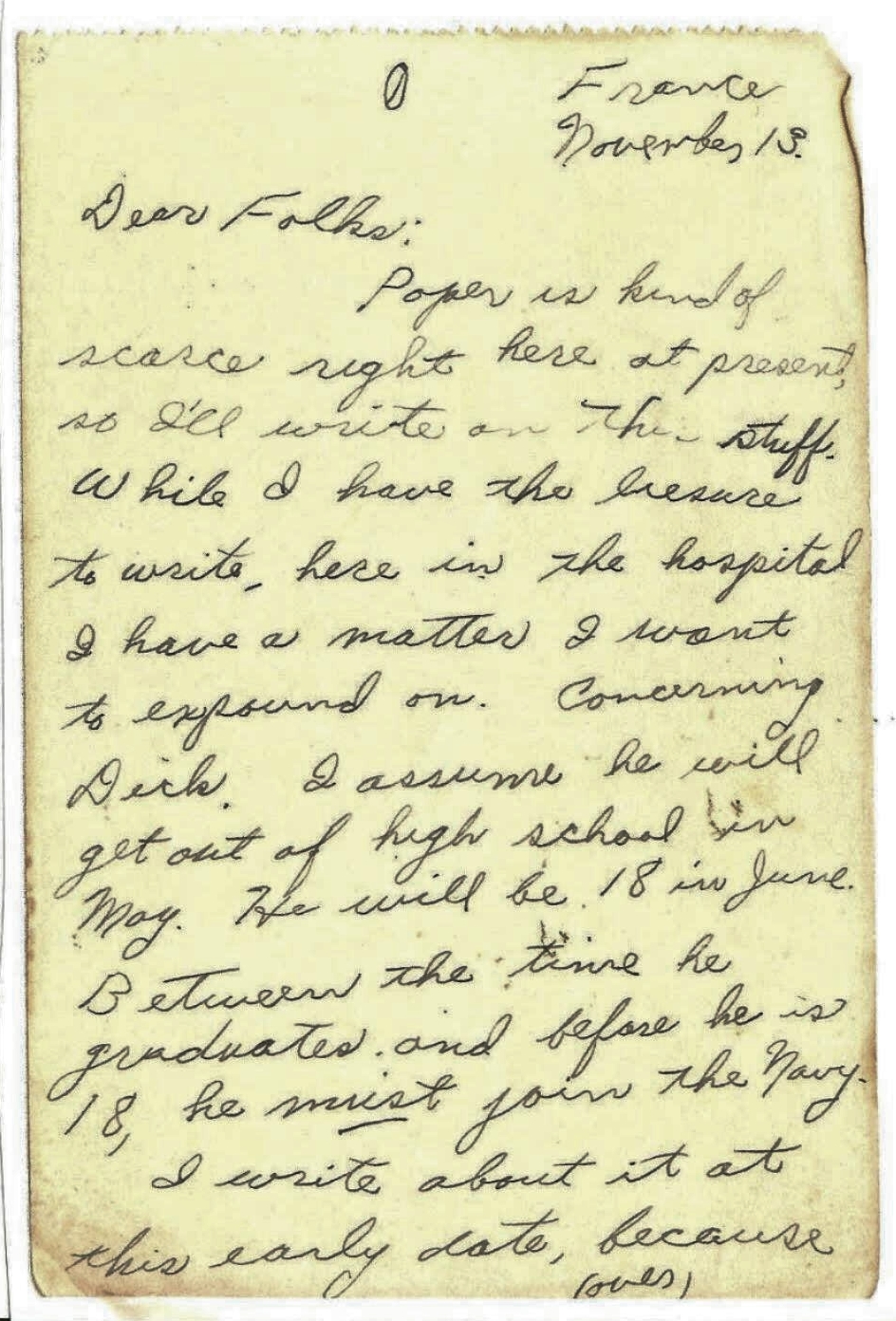
A Big Brother's Urgent Plea

I am fortunate enough to have the letters my father wrote home during World War II.  One of the most powerful is this one, written from a field hospital in France about a month after he was badly wounded.  I’m going to present it without comment; nothing I could say would add anything.

France - November 13 [1944]

Dear Folks:

Paper is kind of scarce right here at present, so I’ll write on this stuff.  While I have the leisure to write, here in the hospital, I have a matter I want to expound on.  Concerning Dick [my brother].  I assume he will get out of high school in May.  He will be 18 in June.  Between the time he graduates, and before he is 18, he must join the Navy.

I write about it at this early date, because it may be necessary to lay some groundwork.  Have it fixed so he can step right out of high school and into the navy.  It sometimes takes a month or so to get joined up etc., and delay in this case might result in being drafted into the army.  Perhaps they will not take 18 year old volunteers except thru selective service.  Avoid having to register at all by joining when you are still 17.  By all means, make every effort to get into the Navy.

Dick, you might think differently, and have decided that you would rather take the army since you have waited so long.  If so, just pick a night when it is sleeting, take a shovel, and go out and dig a hole in the cornfield 2 feet wide, 5 feet long, and 5 feet deep, pour 6 inches of water in it, and lie down and sleep in it.  You can take the shotgun with you to add atmosphere, but remember, you must clean it before you go to sleep or it will rust.  Of course you must watch out for your buddy while he sleeps, so you don’t get to lie down until 2 a.m.  Have 2 or 3 grenades in your pocket when you lie down.  Also stick your trench knife in the ground beside your head, where it will be handy.  Pull your .45 out of its holster and stick in inside your jacket, and go to sleep with your hand on it. Of course your buddy and you will have to be awake before dawn, ready for a counter-attack.  No, the Navy is much nicer...

I heard over the radio where they are starting a fund to rebuild churches in Italy and Germany.  Don’t give anything to that.  I have been shot at too much by snipers in church steeples... 

I’m still in the hospital.  Feeling much better, and suppose they’ll let me go back [to the front lines] soon... I haven’t had any mail since I left the outfit, so don’t know the news.  Just keep writing and it will catch me.  Don’t worry, I’m O.K.

Love, Bob


Thursday, May 9, 2013

Grave Hunting in the Heartland

It was my Grandma Wallin who first took me to a graveyard—as a recreational activity—when I was about eight. I’ve liked graveyards ever since.

Recently my husband and I were traveling to Holmes County, Ohio, and I thought we might as well visit a few graveyards on the way. His maternal ancestors are buried in a string of graveyards stretching from northern Indiana to central Ohio. So, armed with my “graveyard kit,” we spent a day hunting tombstones.

First stop: Eddy Cemetery, DeKalb County, Indiana—resting place of Charles and Elizabeth Alwood, my husband’s great-great-grandparents. Charles was a private in the Indiana Volunteers during the Civil War. He left seven children at home, the oldest a boy of twelve. His unit fought its way through the south, eventually ending up in North Carolina, where they occupied Raleigh and then cooled their heels waiting for the war to end. After it did, but before he could get back home, Charles died of typhoid in an army camp there. Elizabeth lived forty more years as a widow, running their farm as well as she could. We left a flag at his grave.


Second stop:  Independence Cemetery, Defiance County, Ohio—resting place of John Jr. and Mary Ann Garver, my husband’s great-great-grandparents.  There we had the great pleasure of meeting up with the woman who cared for this church cemetery along with her husband.  We had corresponded with her ahead of time and determined that her husband is a distant cousin of my husband, and she surprised us with an envelope of photographs which were ours to keep.


Third stop:  Florida Cemetery, Henry County, Ohio—final resting place of Jacob Heilman and his family—once again, my husband’s great-great-grandparents.  Jacob, an immigrant from Bavaria, was in the 68th Ohio Infantry in the Civil War, and theirs is an incredible tale.  His unit fought in every Confederate state except Florida and Texas, and during the course of the war, he marched over 7,000 miles and rode trains or steamboats another 6,000.  He lived to tell the story, going on to have twelve children—six before the war and six after—and he died at 88.  After taking some photographs, we put a flag on his grave and were on our way.  We had a long drive to our next stop.


Fourth stop:  Walters Cemetery, Morrow County, Ohio—final resting place of John Garver Sr. and his wife Elizabeth—my husband’s great-great-great grandparents.  John Sr. was born in 1795 and died in 1879.  He fought in the Pennsylvania Militia in the War of 1812, and was given a 40-acre piece of government homesteading land (“bounty land”) for his service and a pension in his old age.  Three of their daughters predeceased them and are buried with them—all three died in the 1840s, at ages 20, 16, and 2.

Not every husband would spend an entire day finding cemeteries and cleaning gravestones for his wife, especially on vaction...  Kudos to mine for being such a good sport!